Arthurian Hero Character Design Project
Dungeons & Dragons 5e, Level 10
In a Development of Western Civilization Colloquium (DWC 202) entitled Studying the Middle Ages through Medieval & Modern Games, Professors Christopher Berard and Aaron Colaiacomo teach a unit that integrates their respective specializations in medieval Arthurian legend and the modern fantasy game Dungeons & Dragons. Students learn the main characters, plots, and conflicts of King Arthur’s mythical court. They also delve deeply into the cooperative storytelling, tabletop roleplaying game that is Dungeons & Dragons. At the end of this unit, students complete a capstone assignment that combines these two areas of study.
This engaged learning project asks students to select an Arthurian character appearing in Myths and Legends of the British Isles, edited by Richard Barber (Woodbridge, 1999), and / or in A Dictionary of Medieval Heroes, edited by Willem P. Gerritsen and Anthony G. van Melle, translated by Tanis Guest (Woodbridge, 1998), and then to translate that character faithfully as a tenth-level Dungeons & Dragons character according to the rules of the fifth edition of Dungeons & Dragons (2024 Player’s Handbook).
The purpose of this assignment is to foster close reading and critical character analysis and to show how medieval characters can be expressed using the popular modern ludic framework of the Dungeons & Dragons fantasy roleplaying game. The assignment consists of a Dungeons & Dragons character sheet and a written explanation of the interpretive decisions that were made.
Below is the structure of the written component of the project:
- The first paragraph names and briefly introduces the character selected. It also provides an overview of the major interpretive choices made with respect to character design.
- The second paragraph covers categories of identity: race, language, class(es), sub-class(es), and background. Evidence from the medieval source material is provided to justify each selection.
- The third paragraph covers ability scores and skills. The discussion includes the character’s strongest ability scores, weakest ability scores, and leading skill proficiencies. Evidence from the medieval source material is provided to justify each selection.
- The fourth paragraph covers character abilities: spells, feats, equipment, and special features of class/sub-class selections. The three strongest choices are discussed. Evidence from the medieval source material is provided to justify each selection.
- The fifth paragraph covers character alignment. Evidence from the medieval source material is provided to justify each selection.
- The sixth paragraph contains a crystallizing conclusion.
-
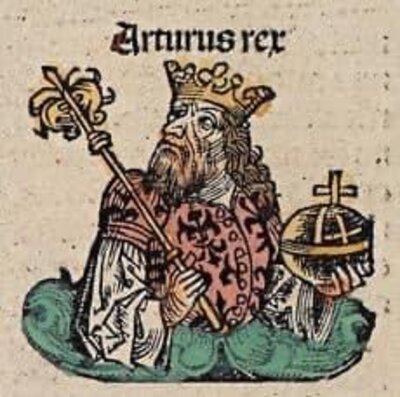
Arthur Pendragon, King of Britain
Jacob G. Bowser
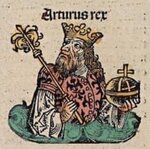
King Arthur’s historical existence is uncertain, but he may have been a real person, a myth, or based on another figure. The best-known account of his background is from Geoffrey of Monmouth, written around 1136 during the Anglo-Norman dynasty. Arthur is said to have lived in the fifth or sixth century.[1] Reportedly, the son of a British king, he took the throne at age fifteen and married Guinevere. Arthur’s famous sword is Excalibur, and his shield, Pridwen, bears the image of the Virgin Mary. As a king, he conquered Norway, Denmark, and Gaul, and focused on defending his realm and strengthening internal relations. Summoned by the Romans, Arthur left his nephew Mordred in charge, who then seized the crown. Arthur defeated Mordred in three battles but was mortally wounded in the last. Before dying, he named his nephew Constantine as his successor and spent his final days on the Isle of Avalon. For these reasons, he is represented in Dungeons and Dragons as a Paladin and Bard with high strength, reflecting his status as the ideal medieval king and warrior.
[1] Frank Brandsma, ‘Arthur’, in Willem P. Gerritsen and Anthony G. van Melle (eds), A Dictionary of Medieval Heroes, trans. Tanis Guest (Woodbridge, 1998), pp. 32–44, at p. 32.
-
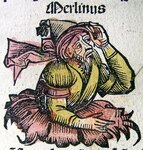
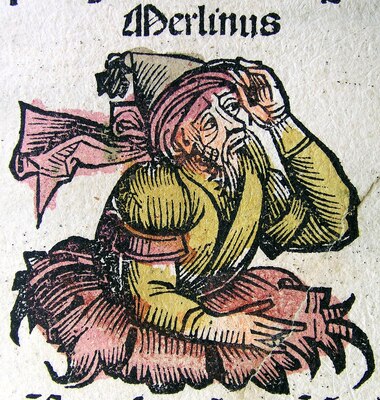
Merlin, Wizard of Dyfed
Dermot J. Drew
Merlin is a legendary figure of the Arthurian era and appears across numerous medieval texts. The Life of Merlin describes him as having “lived his life under many kings” and enjoyed the fame as he predicted the future for rulers.[1] Through the use of the Dungeon and Dragons Player’s Handbook and medieval texts, I have created Merlin with an identity as a Human Wizard, sage background, profound intelligence and wisdom, powerful abilities, and a neutral good alignment.
[1] 'The Life of Merlin', trans. Neil Wright, in Richard Barber (ed), Myths and Legends of the British Isles (Woodbridge, 1999), pp. 118–45, at p. 118.
-
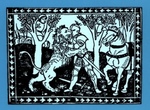
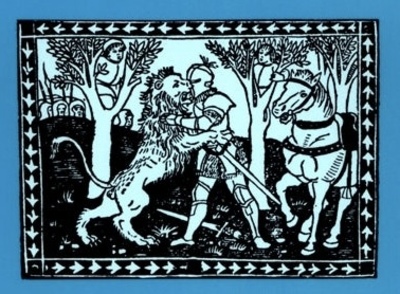
Sir Ywain, Knight of the Lion
Connor J. Jones
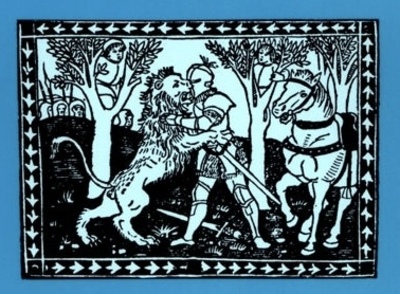
Yvain, the noble and chivalric “Knight of the Round Table,” exemplifies many knightly qualities throughout his life in combat. However, his greatest conflict is not in battle, but within himself as he struggles between his marital obligation and personal pursuit of chivalric responsibility as a member of Arthur’s court. As he matures and grows as a noble knight, his devotion shifts toward aiding the helpless and combating evil. This growth, beginning with his withdrawal from society, reflects his emergence as an honorable knight and is evident in his exceptional Strength, Wisdom, and Charisma. His unique feats and spells, such as Animal Friendship, Primal Companion, and Locating Animals and Plants, along with his lion companion and Lawful Good alignment, define the great knight that he is.
-
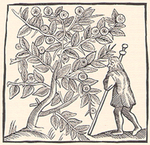
Joseph of Arimathea, Saint
Avery M. O'Neil
Joseph of Arimathea is a biblical figure known for courageously requesting Jesus’s body after the crucifixion and placing it in a tomb. In medieval tradition, he is also linked to the Holy Grail and described as a missionary who traveled to Britain, spreading Christianity and guiding followers. Based on historical and legendary texts describing his life, Joseph of Arimathea is best represented in Dungeons & Dragons as a human cleric of the Life Domain with a Guide background, as his actions consistently demonstrate an active relationship with divine power, the spreading of spiritual life, and leadership through guiding others both physically and spiritually. His wisdom, intelligence, and moral decisions make him a clear embodiment of a lawful good cleric.
-
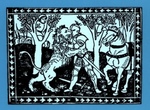
Sir Yvain, Knight of the Lion
Paul J. Schwartz
Sir Yvain is one of King Arthur’s Knights of the Round Table. He appeared in quite a few stories associated with the Matter of Britain, although almost never as a major character. He was typically portrayed as a loyal supporter and knight of his king. He was also one of the few Arthurian characters seemingly based on a real individual, Owain, a Brythonic king of Rheged; he was engaged in warfare against the Picts, and maybe the early Anglo-Saxon migrations in the late 6th century.1 By examining his martial abilities, his bond with his lion companion, his noble origins, and his chivalric code, Yvain is best described as a Human Beast Master Ranger of Noble background and Lawful Good alignment.