Medievalism & Modern Games Capstone Project
Designed by: Christopher Berard & Aaron Colaiacomo
Description
This project synthesizes the semester’s readings, discussions, and assignments by demonstrating how modern games engage with the medieval past.
Students will select a game and critically assess how it relates to the medieval period studied in class. The project includes three components: Essay, Presentation, and Peer Evaluation.
Essay Structure
- Introductory Paragraph: Identify the game, including its name, inventor and/or publisher, and date/place of release or publication. Introduce the overarching arguments related to medieval context, ludic context, and major themes.
- Medieval Context: Identify medieval aspects of the game, including setting(s), character(s), and conflict(s). Analyze where the game falls on the spectrum between history and fantasy.
- Ludic Context: Identify the type of game, mechanics, gameplay, and other relevant ludic features. Analyze how the game represents and facilitates interaction with medieval history and fantasy.
- Major Themes: Relate these themes back to PERSIA (Political, Economic, Religious, Social, Intellectual, Artistic) with reference to Robert Houghton’s The Middle Ages in Computer Games (2024).
- Conclusion: Provide a crystallizing conclusion that synthesizes the essay.
Sources & Citations
First pertinent footnote:
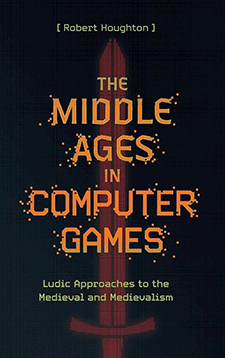
Robert Houghton, The Middle Ages in Computer Games: Ludic Approaches to the Medieval and Medievalism (Cambridge, 2024), p. 5.
Subsequent footnotes:
Houghton, Middle Ages in Computer Games, p. 5.
Chapter citation model:
Eve Stirling and Jamie Wood, “Learning About the Past Through Digital Play: History Students and Video Games,” in Teaching the Middle Ages through Modern Games, ed. Robert Houghton (Berlin, 2022), pp. 29–43, at p. 30.
Subsequent chapter footnotes:
Stirling and Wood, “Learning About the Past Through Digital Play,” p. 31.
Presentation
Using the essay as a script, create a 7–10-minute PowerPoint presentation that introduces the chosen game and situates it in relation to the medieval period.
Peer Evaluation
Write two separate peer evaluations, each approximately 150–200 words. Each response must critically analyze what you learned and offer both critiques and praise.