
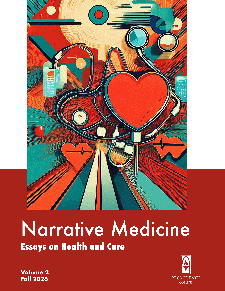
Volume 2, Issue 1 (2026) Narrative Medicine
Editor’s Note
Nearly four decades ago, Susan Sontag noted that “Illness is the night-side of life, a more onerous citizenship. Everyone who is born holds dual citizenship, in the kingdom of the well and in the kingdom of the sick. Although we all prefer to use only the good passport, sooner or later each of us is obliged, at least for a spell, to identify ourselves as citizens of that other place.”1 This issue of Narrative Medicine features stories about how patients and families cope with illness and injury in that ‘other place.’ We hope that readers will see themselves and others in these stories. Our authors explore the corollaries of both acute and chronic conditions, including anxiety, fear, pain, and loss. Their narratives also highlight the importance of family and friends, hope, hard work, and resilience in coping with the challenges they face on the night side of life.
Disease cannot be reduced to a simple diagnosis. It is a lived experience that shapes our interpersonal relationships, our work lives, and even our sense of self. As Meghan O’Rourke wrote in her essay on autoimmune disease in The New Yorker, “One of the hardest things about being chronically ill is that most people find what you’re going through to be incomprehensible - if they believe you are going through it.”2 We hope readers will gain new appreciation for the psychological toll that illness imposes on patients and families. In this issue, several authors underscore how their chronic conditions and injuries affected their emotional health, sense of purpose, and daily routines. Illness and injury, in short, upend our norms and replace them with uncertainty.
As patients share their stories, they educate family members, friends, and their clinicians about the burdens they carry every day. In many cases, particularly with poorly understood or newly defined conditions, physicians don’t always believe the stories their patients tell. For example, as Jerome Groopman notes in his essay on the history of fibromyalgia, many doctors dismissed patients’ complaints about chronic fatigue, headaches, insomnia, and pain as a psychological condition, rather than a physiological one.3 Similar controversies appeared with new diagnoses such as chronic fatigue syndrome and post-traumatic stress disorder. Randy Shilts’ extraordinary chronicle of the first decade of the AIDS epidemic also highlights the vital role patients’ stories played in defining an emerging infectious disease.4 Activists shared their own stories and pressed public health officials to acknowledge and respond to their struggles at a time when public officials at both the federal and state level refused to talk about it.
Sometimes injury or illness strikes suddenly, without warning, leaving patients and their families reeling. In other cases, chronic or recurring conditions progress incrementally over months or years despite patients’ best efforts to manage them. The United States health care system is particularly well suited to treating patients with acute conditions that are of short duration and respond well to clearly defined treatments or therapies. The Emergency Medical Treatment and Active Labor Act of 1986 (EMTALA) requires hospitals to treat and stabilize any patients who present themselves for care at a hospital emergency department, guaranteeing access to basic lifesaving care for all patients. Patients often face significant barriers in managing chronic conditions such as diabetes, hypertension, or obesity, however, particularly individuals who lack health insurance or who live in medically underserved communities.
This issue also features a new contribution by Dr. Michael Stout, a thoughtful physician-author who is well-known to many Health Sciences students at Providence College. Dr. Stout generously gave his time to students in my courses on the Profession of Medicine during the 2023-24 academic year, sharing his decades of experience and insights as a practicing physician with students on numerous occasions. He continues to work part-time in an urgent care practice in Washington, DC, where he is also a clinical assistant professor of medicine at George Washington University. Dr. Stout is a regular contributor to Medicine@Brown and is currently working on a book manuscript that introduces readers to what it is like to practice medicine in a changing health care system. We look forward to sharing perspectives from other practicing clinicians with readers through our new Clinician’s Corner in future issues.
Beginning with our next issue, a student editorial board will review all submissions through a blind peer-reviewed process. Our student editors for the 2026-27 academic year are featured at the end of this issue.
Robert Hackey, PhD, Professor of Health Sciences Co-Editor, Narrative Medicine: Essays on Health and Care
References
- Susan Sontag, “Illness as Metaphor.” New York Review of Books. January 26, 1978. Available online at Illness as Metaphor.
- Meghan O’Rourke, “What’s Wrong with Me?” The New Yorker. August 19, 2013. Available online at What’s Wrong with Me?
- Jerome Groopman, “Hurting All Over.” The New Yorker. November 6, 2000. Available online at Hurting All Over.
- Shilts, Randy. And the Band Played On: Politics, People, and the AIDS Epidemic. New York: St. Martin’s Press, 1987.
Articles
Power of Badass
Jessica A. Smith
Entre Inglés y Español (Between English and Spanish): My Father’s
Fight for Understanding
Glorimar de los Santos Mejia
Just a Stomachache
Jillian M. Spinali
You Can Play!
Brianna L. De La Fuente
What Normal Costs
Clare C. Diffin
Editors
- Dr. Robert Hackey, Co-Editor
- Bob Hackey is a professor of health sciences at Providence College, where he teaches courses on the profession of medicine, policy analysis, and introduction to the health professions. He was selected as the Carnegie/CASE Professor of the Year for Rhode Island in 2008 and has published widely on state and national health policy issues for over three decades.
- Will Toner, Co-Editor
- Will is an Assistant Dean of Student Academic Success and Director of Peer Education at Providence College, which includes executive oversight of the Writing Center. He studied creative writing as an undergraduate before focusing on writing pedagogy as a graduate student of English at the University of Maine. Prior to joining PC in 2011, Will taught college-level writing courses and published as a local journalist in Newport County, RI.
- Megan Lessard, Design Editor
- Megan is the Head of Digital Projects & Metadata (DPM) at Providence College, where she supervises the multifaceted DPM Team within Phillips Memorial Library. Her work focuses on digital scholarship, publishing, metadata, accessibility, media instruction, and project management. She holds a Master of Education in Higher Education from Providence College and a Bachelor of Fine Arts in Professional Photographic Illustration from the Rochester Institute of Technology.
- Vanessa Colina ’27
- Vanessa is a sophomore from Norton, Massachusetts, majoring in Health Sciences while following a pre-med track. Throughout her time volunteering at Hasbro Children’s Hospital, she has become even more confident in her goal of becoming a pediatrician.
- Brianna De La Fuente ’27
- Brianna is a sophomore at Providence College, majoring in Health Sciences. She is interested in becoming a PA and is passionate about practicing medicine. Outside of her academics, she is a Division 1 student-athlete, playing softball for PC.
- Kathryn Lundquist ’27
- Kate is a senior Health Sciences major at Providence College on the Physician Assistant track. Through her involvement in campus leadership, healthcare, and community service, she is passionate about bringing thoughtful perspectives to the Providence College community and contributing to meaningful conversations on campus.
- Tanner Marshall ’27
- Tanner is a senior at Providence College. She is a Health Sciences major on a pre-accelerated nursing track and a School of Nursing and Health Sciences Student Ambassador.
- Chloe Turano ’27
- Chloe is a senior from Westerly, RI, majoring in Health Sciences. After finishing her undergraduate degree, she plans to attend Physician Assistant School. In addition to her strong interest in learning about the human body and how it works, she is also interested in the science behind the structure of living organisms.
- Molly O’Neill ’29, Editorial Assistant
- Molly is a Health Sciences major with a Business and Innovation minor at Providence College with a passion for healthcare and research. She is honored to serve as the journal’s Editorial Assistant and excited to collaborate with others who share meaningful perspectives on medicine, research, and the experiences that shape patient care.